The Off-Camera Month: Thirty Days of Making Things With the Door Closed
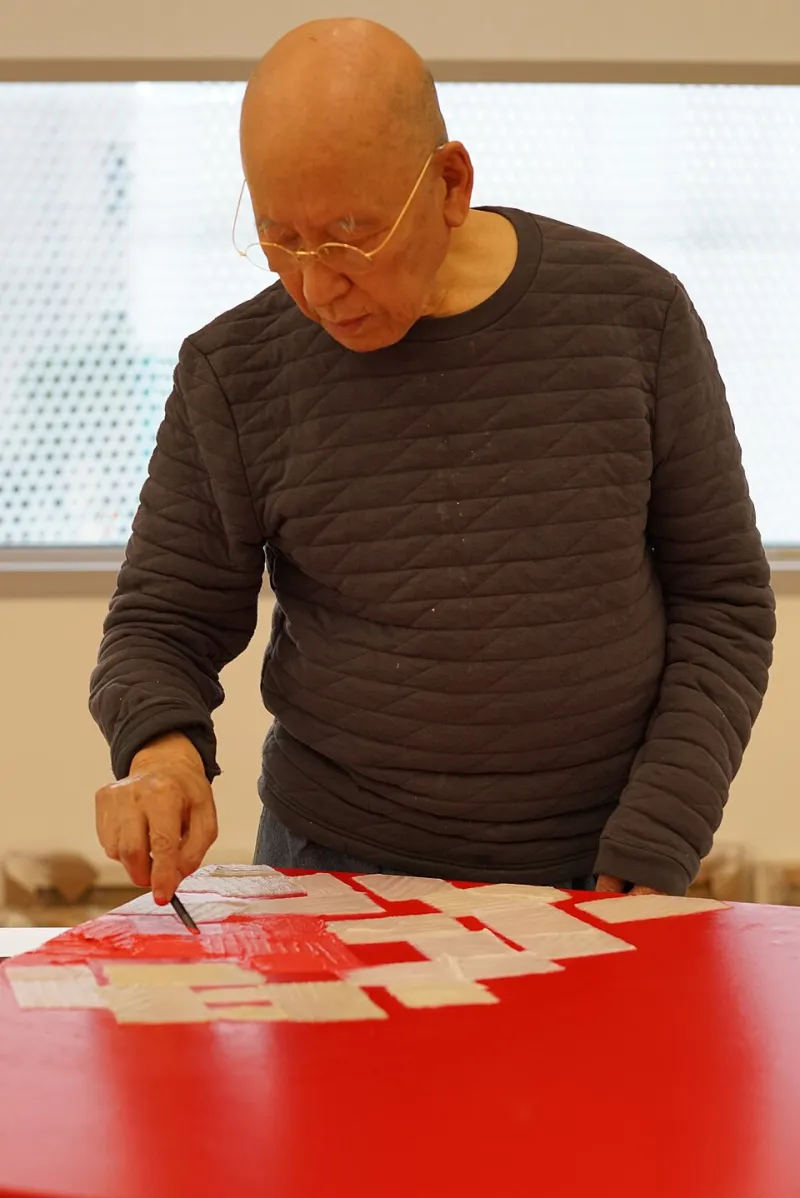
Photo: 선의의 바람, CC BY-SA 4.0, via Wikimedia Commons
For thirty days this past October, I made one thing a day and showed it to no one. No posts, no stories, no quick-look texts to the group chat. Not even a portfolio folder. Just a stack of paper, a few questionable glue joints, and a legal pad where I wrote one line about each piece. This was not a productivity challenge. It was an experiment in taking the audience out of the room and seeing what remained.
I called it the off-camera month. The premise was simple: one piece per day, no audience, no plan for where any of it would go. I wanted to know whether privacy would make me braver, faster, or just quieter. The answer turned out to be all three, in an order I did not expect.
The Rules, and the One I Broke
I set three rules. One piece per day. Thirty to ninety minutes, start to finish. No audience of any kind—no posting, no previews, no asking for feedback, no filing anything into a portfolio folder for later. I kept a private log instead, one line per piece, mostly so I could remember what I had made. Entries looked like: "Paper loop, too tight, liked it anyway" or "Bad pink, good shape, stopped at 47 minutes."
I broke one rule on day 12. I showed my partner a piece because it was dripping on the floor and I needed a second pair of hands, not a second opinion. That felt like a loophole. Otherwise, the door stayed closed.
The first few days were strange. I kept reaching for my phone to photograph a piece before I had even decided if it was finished. The reflex was almost physical. Making without documenting felt like cooking without tasting—possible, but oddly incomplete. By day five, the reflex faded. By day eight, I stopped thinking about the camera entirely.
Risk Without a Scoreboard
Normally, when I make something, a tiny editor sits on my shoulder. It asks whether the piece would work in a portfolio, whether it reads clearly at thumbnail size, whether it fits whatever story I am telling about my work that month. That editor is not evil. It is just relentless.
Without an audience, the editor went quiet. I chose uglier colors. I cut shapes wrong on purpose. I used a stapler as a joining method and did not apologize to anyone, including myself. One piece looked like a stressed-out croissant. Another was a flat slab of gray with a single orange notch cut into the side. I liked the notch. I would never have put the slab in a portfolio, and that was the point.
Privacy turned out to be a permission slip. When no one is going to ask "what does it mean?" you can find out what it means on your own time. I took more risks because the stakes were lower. Not every risk paid off, but the failures were cheap and quick. I made more bad work in thirty days than I usually make in three months, and I mean that as a compliment.
Speed: The Work Ends When It Ends
I expected the no-audience rule to slow me down. It did the opposite. When there is no caption to write, no photograph to color-correct, no preview to send, the work ends when it ends. I stopped sanding edges that no one would see. I stopped reworking pieces that had already said what they needed to say.
My average session was fifty-two minutes. Some pieces took twenty. A few took ninety. The timer was not a deadline; it was a boundary. Without an imagined viewer, I made decisions faster because I was not trying to anticipate a reaction. I was just trying to solve the problem in front of me.
Speed also made the work more decisive. When you know you are not going to show something, you stop hedging. You pick the darker color. You cut the shape. You glue it down and move on. I finished eight pieces in the first week before dinner, which never happens. By week three, I had a rhythm: make, log, put it on the shelf, close the door.
Satisfaction: Quiet, Then Loud
The first week felt like feedback withdrawal. I am not proud of that, but it is true. I am used to a small amount of reaction—a text, a like, a friend saying "oh, that one." Without it, the silence was noticeable. On day nine, I felt silly. I was making objects for no one, stacking them on a shelf like a squirrel with a very specific hoarding problem.
Then something shifted. By week three, I liked the work more. Not because it was better, but because my own judgment had room to get louder. The silence was not empty; it was roomy. I could hear myself decide. I could tell which pieces I was making for the pleasure of making and which ones I was making for an imaginary audience that had never actually asked for anything.
Satisfaction came in two waves. The first was quiet: a good hour, a decent cut, a shape that held. The second was loud: the realization that I did not need the work to be seen in order for it to count. That sounds obvious. It is harder to practice than to say.
The Hidden Wing
Museums keep most of their collection off view. The show is the tip; the storage is the body. I used to think of my practice as the show. The off-camera month made me think about the storage.
A hidden wing is not a graveyard. It is a gym. It is a place to try bad ideas without turning them into content, to make things that are not portfolio-shaped, to practice without a scoreboard. Not every creative practice needs a public-facing wing every day. Some need a room where the door closes and the work gets to be unfinished, unattractive, or simply private.
I am not arguing that everyone should hide their work forever. I am arguing that the portfolio is not the whole building. The unseen pieces taught me more about my taste than the last ten things I posted. They also made me less desperate about the next thing I share.
What I'm Keeping
I am not keeping all thirty pieces. Some are bad. Some are already falling apart. But I am keeping the practice. I am keeping a no-audience shelf in the studio—a place where work can sit without being photographed, captioned, or explained. I am also keeping a hidden week each quarter, seven days where I make one thing a day and show no one.
The experiment did not make me want to quit sharing. It made sharing feel less like a verdict. The work can have a private life and a public one. The door can open and close. The portfolio can be a room in the building, not the entire address.