No Title, No Price, No Preamble: A Week of Letting One Print Fend for Itself
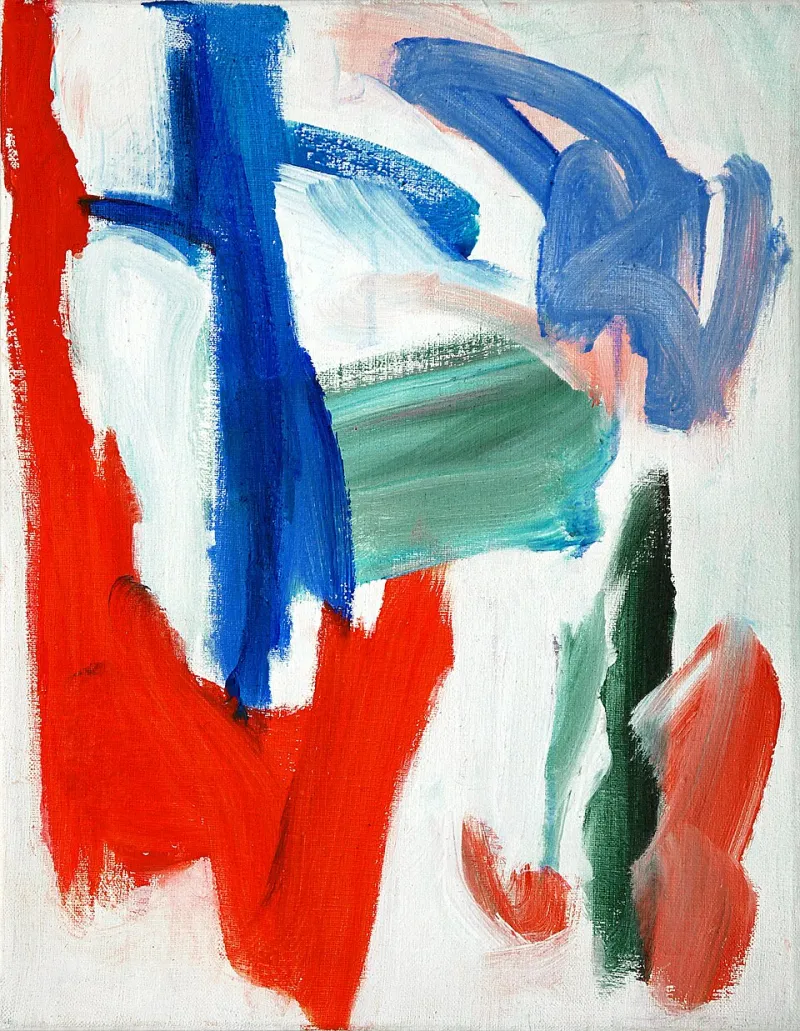
Photo: Fons Heijnsbroek, CC0, via Wikimedia Commons
On a gray Tuesday morning in November 2026, I walked into my neighborhood coffee shop with an 8-by-10 print in a plain black clip frame and asked the barista a small favor: could this live on the wall by the window for a week? No label. No price. No QR code. No tiny card explaining the series, the process, or the mood I was chasing. Just the image.
She said yes. I ordered drip coffee, sat near the door, and tried not to stare.
This was not a stunt, and it was definitely not a marketing plan. It was a low-stakes test of a question that has been nagging me in the studio: what does the work do when I am not standing next to it explaining? Friends are kind. Friends know the story. Friends have already seen the messy middle. A café on a Tuesday does not.
The Rules, Such as They Were
The print had no title and no signature on the front. I picked a piece that leaned abstract but kept a few recognizable edges, something that could survive a little misinterpretation without falling apart. I did not post about it. I did not tell anyone except the barista. I came by four times for about twenty-five minutes each visit, ordered something, and took notes in a pocket notebook like a person who has watched too many detective shows.
That was the whole method. One object, one room, seven days, no narration from me.
What People Asked
The questions split into three buckets: ownership, transaction, and story. Ownership sounded like “Is this yours?” or “Do you know who made this?” Transaction sounded like “Is it for sale?” or “How much?” Story sounded like “What is it?” or “Is it supposed to be a map?”
The barista got most of them. She told me one guy asked if it was a new menu. Another asked if it was a missing poster. I loved that. A missing poster. My little abstract print apparently had the energy of a lost dog.
No one asked about process. No one asked what software I used. No one asked about the series. That was a useful bruise. I had been writing captions as if the first question a viewer asks is “How?” Most people start with “What am I looking at?” or “Can I buy it?” or “Why is it blocking the outlet?”
The transaction question was the most common. In a café, art reads as commerce or decoration. That is not an insult. It is a context. If I want a piece to work in public, it needs to hold up as an object in a room, not just as a file in a portfolio grid.
What Got Ignored
Plenty. Some people walked by all week without a glance. A few used it as a landmark: “I’ll meet you by the picture.” One person straightened it. Another moved it slightly left because it was near a glare. The piece became furniture, and that was informative. It did not demand attention. It waited.
In a portfolio, every image is center stage. In a café, the work is background until someone decides otherwise. That forced me to ask whether the piece had enough pull on its own. Some days I thought yes. Some days I thought it looked like a placeholder for a better idea.
That is not a failure. That is data.
What People Invented
This was the fun part. A woman at the counter said it looked like “a map of a conversation.” A guy in a fleece jacket told his friend it was “probably a coastline.” Someone else thought it was a receipt blown up huge. A couple spent two minutes debating whether it was hung upside down. I had not intended it to be hung upside down, but I also had not put an arrow on it. Their debate was better than any caption I could have written.
People will invent a story if you leave a gap. That is not a bug. It is the job. The question is whether the gap is generous or just confusing. In this case, the gap was mostly generous. The piece gave people enough shape to argue with. It did not give them a lecture.
What I Changed
I went back to my project page and cut a paragraph. It was a good paragraph, maybe. It explained the emotional arc of the series in a way that made me feel safe. But the café test showed me that safety was not the same as clarity. I replaced it with one line that gives a handle without closing the door. I also stopped putting the title first in every caption. Sometimes the image needs a second before the words start talking.
I am not saying every piece should be anonymous. I am not saying labels are bad. Wall text can be a gift. But there is a difference between a caption that helps someone enter and a caption that does the looking for them.
The Small Takeaway
On day seven, I took the print down, wiped the frame, and left. The barista asked if anyone had bought it. I said no. She said, “That’s okay. People liked having it there.” I thought about that for the rest of the week.
A portfolio is not a café wall. But sometimes I treat it like a courtroom where I have to explain every choice. This was a week of not explaining. The work did not collapse. Some people ignored it. Some people invented a coastline. One person thought it was a missing poster. All of that was more useful than another round of nice comments from people who already know the story.
If you want to try it: pick one piece, print it cheap, ask a local shop if it can hang for a week, and do not post about it. Sit nearby. Take notes. Let the silence do some editing. You do not need a big audience. You need a few people who have no reason to be polite.