The Kitchen-Timer Sketchbook: What I Learn in 45 Minutes Every Week
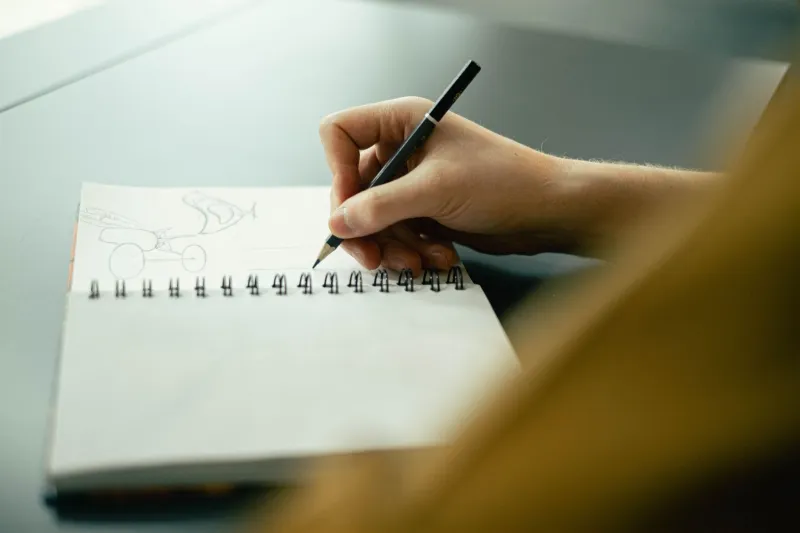
Every Wednesday at 9 p.m., I set a kitchen timer for 45 minutes, put my phone in a drawer, and open a cheap sketchbook. That is the whole ritual. No mood lighting, no curated playlist, no waiting for inspiration to knock. The timer starts, and I draw badly until it rings.
People usually ask about the finished work — the posters, illustrations, the odd little experiments that end up on this site. But most of those ideas begin on a messy page that nobody would mistake for portfolio material. This weekly session is where I test prompts, make bad decisions, and occasionally find the one line or shape that survives.
Here is what the practice looks like from the inside, including the mistakes I keep making and the small choices that turn a rough page into something usable. At the end, I have an invitation for you to try the same exercise and share your page for a future community roundup.
Why 45 Minutes, and Why Weekly
Forty-five minutes is short enough that I cannot talk myself out of it and long enough to get past the first ten minutes of nonsense. A full hour invites overthinking. Thirty minutes can feel rushed. The timer also gives the session a built-in ending, which matters when you have a tendency to keep fixing a drawing until it loses whatever energy it had.
Weekly works better than daily for me. Daily sketchbook challenges tend to become performative; I start making pages for an imaginary audience. Once a week feels private. It is a standing appointment with no deliverables.
The Kit I Actually Reach For
An 8.5-by-11-inch sketchbook with paper thick enough for marker but not so nice that I am afraid to ruin it. A 0.7 mechanical pencil. A kneaded eraser. One gray brush marker. One red colored pencil. A fine-tip black pen. That is it.
I have nicer materials, and using them can be fun, but the good stuff makes me cautious. The drugstore notebook and the beat-up marker do not. The point is not to make a beautiful object. The point is to keep the hand moving long enough for an idea to show up.
The Prompts I Keep on Index Cards
Prompts are not assignments. They are ways to start moving. I keep a small stack of index cards and pull one at random.
- Draw an object on your desk from memory. After five minutes, look at it and draw what you missed.
- Set the timer for one minute and draw the same object three times.
- Combine two unrelated words — say, bus and lamp — into one drawing.
- Make a three-panel story about something that happened this week. No dialogue.
- Draw a sound. Not the thing making the sound; the sound.
- Copy a headline from a newspaper, then illustrate the opposite.
- Fill a page with ten questions about an ordinary corner of the room.
Some prompts fail. That is useful. A failed prompt tells me more than a successful one because it shows where my brain wants to go.
Recurring Mistakes
- Starting with masterpiece ambition. If the first mark is precious, the page is dead.
- Drawing too small. Tiny drawings hide bad decisions; big drawings reveal them.
- Erasing too soon. The wrong line often shows the right one.
- Filling every silence with detail. Emptiness is information.
- Chasing symmetry. Faces and objects do not need to be balanced to be alive.
- Ignoring boring objects. The chair, the mug, the tangle of charging cables — these are the things that teach observation.
I still make all six. The difference is that now I notice them while they are happening, which makes the page less about producing a result and more about paying attention.
The Small Decisions That Make a Page Useful
At the end of the 45 minutes, I do not clean up the page. I make it useful. I date it. I circle the one mark that surprised me. I write a single sentence underneath: what changed between the first minute and the last. If a drawing suggests a larger idea, I put a star next to it and leave it alone.
The next day, I look again for two minutes. That second look matters. What felt like a mistake at 9:43 p.m. can look like a direction at 8:15 a.m. I transfer only one idea out of the sketchbook — a shape, a color combination, a question — and start the finished work from there. The rest of the page stays rough. Rough pages are allowed to stay rough.
What Comes After the Timer
Most weeks, nothing comes out of the session that anyone else will see. That is not failure. The sketchbook is compost. It feeds the work slowly. Other weeks, a page turns into a poster, a short story, or a scene for a vertical video. I never know which is which until later, and that uncertainty is part of the point.
Try It With Me
Here is the whole exercise: pick a prompt, set a timer for 45 minutes, and use whatever materials are already within reach. Work on one page. Do not erase more than three times. When the timer rings, date the page, circle one thing that surprised you, and write one sentence about it.
If you want to share, send a phone photo or scan to the contact page at shinyahayashi.com with Sketchbook Roundup in the subject line by December 1, 2026. I will collect a selection for a future community post. You do not need a fancy sketchbook or a clean desk. You need a timer, a page, and the willingness to make something that is not ready yet. That is the practice.